
Institutional investors — pension funds, banks, real estate funds — don't buy buildings. They buy financial instruments backed by buildings: structures with clear ownership, predictable cash flows, and defined exit strategies.
The difference between "owning a building" and "owning an investment asset" is purely legal and financial architecture. This article breaks down the international models and their application in Uzbekistan.
Why Simply "Owning" Real Estate Isn't Enough
When an individual or legal entity simply owns a building or land in their own name, the asset remains "frozen." Institutional investors — funds, banks, corporations — cannot enter such an asset because:
- there is no transparent legal structure;
- there is no standardized financial reporting;
- the owner's risks and the asset's risks are not separated;
- there is no entry and exit mechanism for investors.
Global private equity practice has long solved these problems using specialized legal structures. Let's examine them.
International Structuring Models
Special Purpose Vehicle (SPV)
An SPV (Special Purpose Vehicle) is a legal entity created solely to own a specific asset or group of assets. In global practice, an SPV is the foundation of any real estate transaction in private equity.
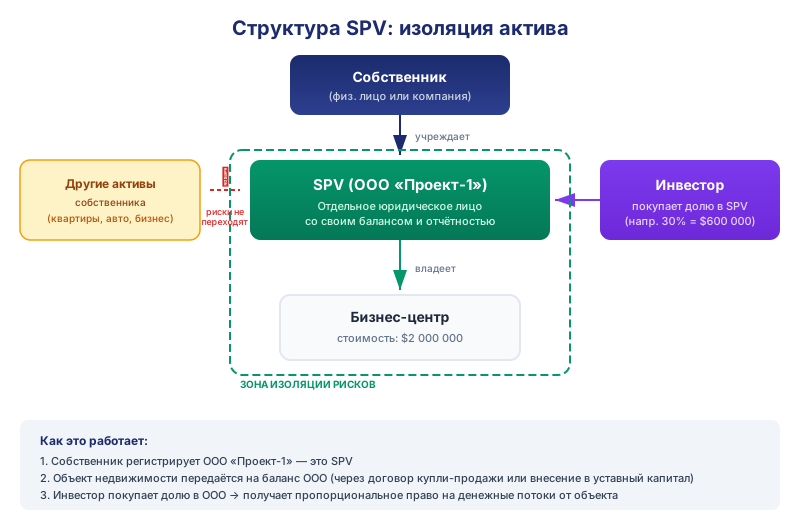
SPV structure: asset isolation within a separate legal entity
How it works in practice. Suppose you own a business center worth $2,000,000. Currently, it's registered in your name as an individual. To turn it into an investment asset, you do the following:
- Create an LLC (or JSC if you plan to raise multiple investors). This company's sole purpose is to own the business center. The company's charter clearly states this.
- Transfer the property to the SPV through a properly documented transaction with notarization and state registration of the property rights transfer. The building now sits on the company's balance sheet, not yours.
- You own 100% of the SPV. Your personal liability is limited to your investment in the company. The building's liabilities (mortgages, tax claims) are now the SPV's liabilities, not yours.
- Now the SPV can attract investors. An institutional fund can buy a stake in the SPV without buying the building itself. They invest in the company that owns the building. This gives investors accounting transparency and a clear legal pathway to exit through a share sale.
Holding Company Structure
When an investor controls multiple properties, a holding company architecture emerges. The holding owns several SPVs, each of which owns a single property or related properties.
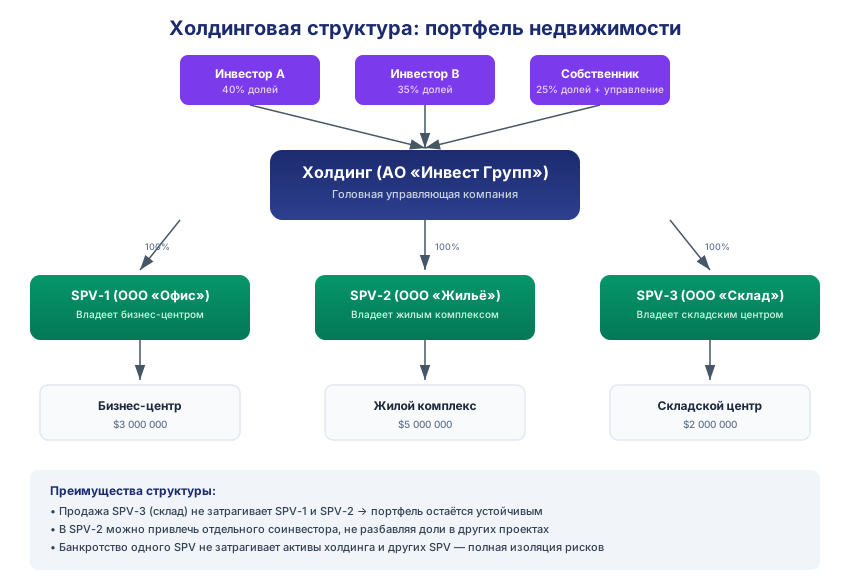
Holding structure: managing a portfolio of multiple properties
Why use it? This structure allows portfolio-level financings (a single loan covers multiple buildings, lowering borrowing costs) while isolating risks per property (if one building underperforms, others aren't affected) and simplifying management reporting.
REITs: The Institutional Standard
A Real Estate Investment Trust (REIT) is a financial instrument that pools capital from many investors to buy and manage real estate portfolios. REITs trade on stock exchanges, making them liquid and accessible to millions of investors.
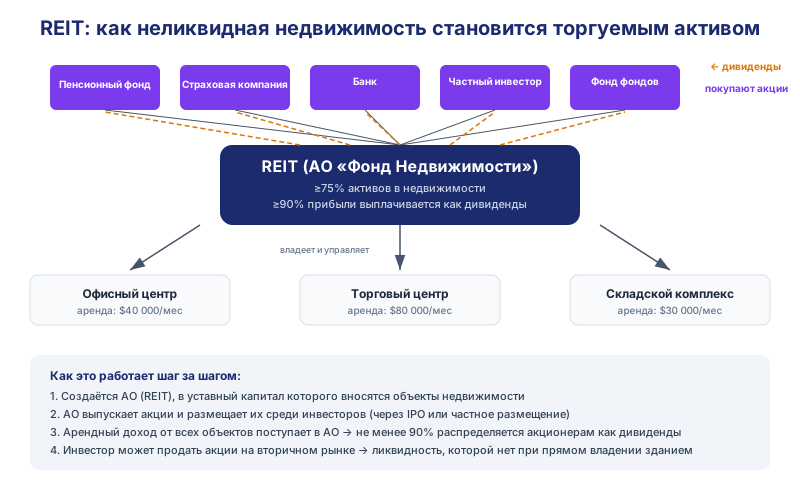
REIT: collective real estate investment with mandatory income distribution
REIT structure: Investors buy REIT shares (publicly traded or private). The REIT manager raises capital, buys properties, manages them, and distributes income to shareholders. Investors get real estate exposure without direct property ownership.
Joint Ventures (JV)
A Joint Venture is a partnership between a local developer (who knows the market) and an institutional investor (who brings capital and expertise). The partners create a joint LLC or JSC to develop, own, and manage the property.
Institutional investors actively use joint ventures to enter new markets.
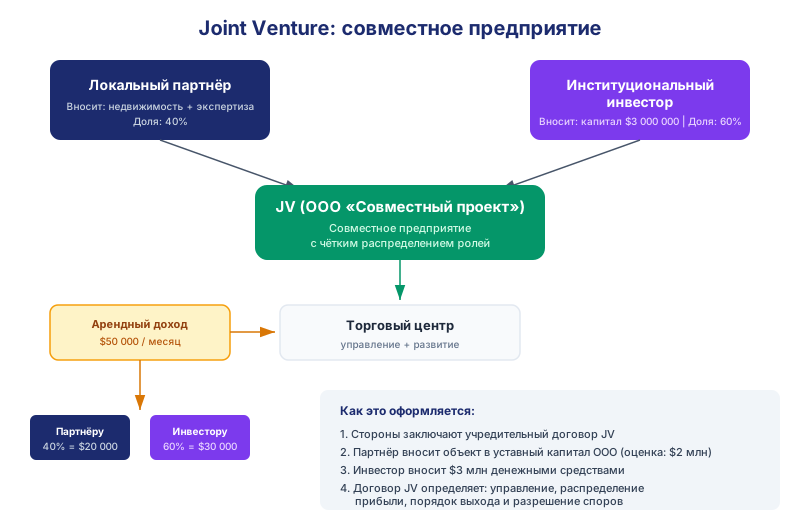
Joint Venture: partnership between a local developer and institutional investor
How it's structured. Suppose you're a local developer with a shopping center. You need capital for reconstruction. An institutional fund wants to enter your market but doesn't know the local specifics. Solution — a joint venture:
- The parties sign a founding agreement and create a joint LLC. You contribute the shopping center (valued at $2 million) and receive 40% stake. The fund contributes $3 million in cash and receives 60%.
- The JV agreement details: who manages the property, how profits are distributed, which decisions require unanimity, and how parties exit.
- Rental income flows to the JV company and is distributed between partners proportionally to their stakes.
- After 5–7 years (typical JV horizon), the property is sold or refinanced. Sale proceeds are distributed per the agreed formula — often using a "waterfall," where the investor first recovers capital plus minimum returns, and remaining profits are split between parties.
Financial Instruments That Make Real Estate "Investable"
In any real estate project, capital is attracted from multiple sources, forming a "stack" — from safest (bank credit) to riskiest (equity).
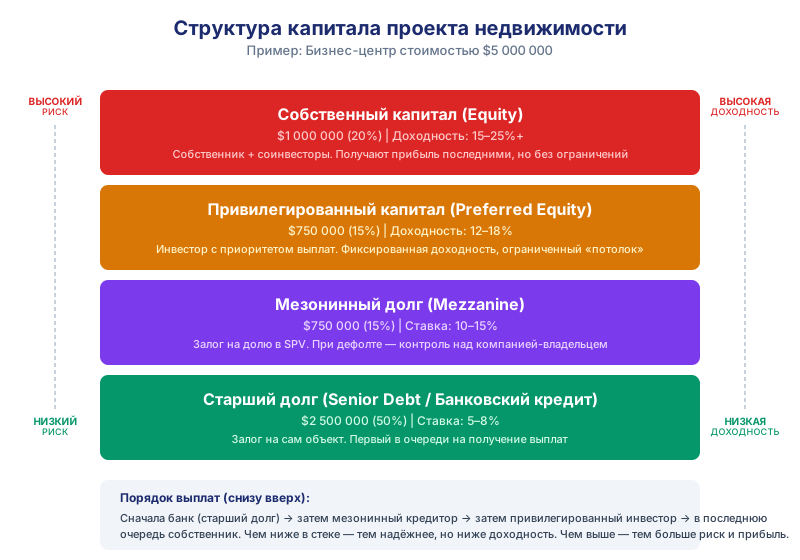
Capital stack: the lower in the stack — the safer, but lower the return
Mezzanine Financing
Mezzanine debt sits between bank credit and equity — hence the name (mezzanine = "intermediate floor").
How it works with a concrete example. You want to buy a business center for $5,000,000. A bank gives you $2,500,000 (50%) secured by the building — senior debt. You have $1,000,000 (20%) of your own. Where do you get the remaining $1,500,000?
- You attract a mezzanine lender — an investment fund or private investor. They provide $750,000 as a loan.
- Key difference from bank credit: the mezzanine lender doesn't take a mortgage on the building (already pledged to the bank). Instead, they take a lien on your stake in the SPV — the company owning the building. If you can't pay, the lender doesn't seize the building — they take control of the company.
- The rate is higher than a bank (10–15% vs. 5–8%) because if you default, the bank gets paid first, and only then the mezzanine lender.
- For you as owner, it's a way to "bridge" financing to the needed amount without giving up a stake in the business. You remain 100% owner of the SPV as long as you service the debt.
Preferred Equity
Preferred equity is an investment in the SPV's equity but with priority in distributions over common equity.
How it works. Same $5,000,000 business center. Bank gave $2,500,000, you have $1,000,000, and you need $1,500,000 more. Instead of a mezzanine loan, you attract a preferred investor:
- The investor contributes $750,000 to SPV equity. They don't become a lender — they become a shareholder with special terms.
- Terms are fixed in the corporate agreement: the investor receives priority income of 14% annually ($105,000/year). These payments are made before you receive any profit.
- When the property sells, the preferred investor is first to recover their $750,000 plus accrued returns. Only then are profits distributed between common shareholders.
- Difference from mezzanine debt: preferred equity is not a loan but a share. The investor has no right to seize assets upon default, but has control rights if returns aren't paid on time. Current market rates — 12–18%.
Securitization (CMBS)
Securitization is the mechanism that turns streams of mortgage payments into tradeable securities. In the USA, the CMBS market is worth approximately $1.8 trillion.
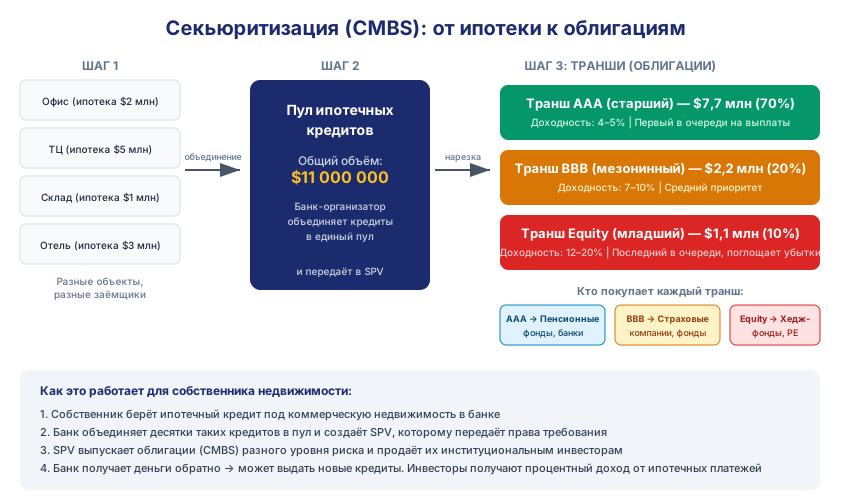
CMBS: converting mortgage streams into tradeable securities
- A bank issues mortgage loans to dozens of commercial real estate owners.
- The bank pools these loans — for example, 50 loans totaling $100 million. The pool is transferred to a specially created SPV.
- The SPV issues bonds (CMBS) backed by this pool. Bonds are "sliced" into tranches of different risk levels: senior (AAA, 4–5%), mezzanine (BBB, 7–10%), junior (equity, 12–20%).
- Institutional investors buy the tranches matching their risk appetite. Pension funds buy AAA. Hedge funds buy equity.
- For the real estate owner, securitization means the bank can easily sell loans, increasing credit availability and lowering rates.
What Institutional Investors Look For
Before investing capital, an institutional investor conducts multi-level due diligence. Here are the key parameters:
Best-in-class properties with stable demand
Properties with proven liquidity, stable cash flow, and predictable demand. Investors seek new or well-maintained properties with minimal capital needs.
Occupancy rates and income stability
Stable rental income, controlled operating expenses, occupancy metrics over 3–5 years. Without this data, an asset is invisible to institutional investors.
"Clean" title and absence of encumbrances
Compliance with zoning, environmental norms, tax law. Investors must see clean title, no hidden encumbrances, and properly documented property rights.
Track record and exit strategy
Owner or management company track record and professional team. And — a clear exit plan: sale, refinancing, or IPO within a defined timeframe.
How This Works in Uzbekistan
Core Legislation
The foundation is the Law "On Investments and Investment Activities" (No. ZRU-598 of December 14, 2019), which consolidated all prior investment legislation. The law guarantees:
- protection of investments from nationalization and confiscation (except emergencies);
- free transfer of funds abroad;
- fair compensation in convertible currency upon any expropriation;
- national treatment for foreign investors (equal rights with domestic investors).
Creating an SPV in Uzbek Law
In Uzbekistan, an SPV can be an LLC or JSC created to own a specific property or real estate portfolio.
Enterprises with foreign capital can be established in any organizational form. Criteria apply:
- foreign participation under 15% — classified as "enterprise with foreign capital";
- over 15% with minimum charter capital of 400 million UZS (approximately $32,000) — "enterprise with foreign investments".
Registration occurs through the Ministry of Justice and regional khokimiyats. For enterprises with charter capital exceeding $20 million, special Cabinet approval may be required.
Investment Funds
The Law "On Investment and Unit Funds" (No. LRU-392 of August 25, 2015) allows creation of investment funds as joint-stock companies. Key requirements:
- at least 75% of charter capital must be paid in cash;
- remaining 25% can be paid with securities, stakes, real estate;
- management through general shareholder meeting, supervisory board, and executive body;
- professional securities market participant as trustee.
This is the closest analog to foreign collective real estate investment vehicles.
Tax Aspects
Key rates for real estate investors
Standard corporate income tax rate is 15%. Property tax for legal entities is 1.5% (3% for incomplete construction). As of January 1, 2026, the tax base is determined by market value of properties.
Capital gains (difference between sale and purchase price, net of costs and depreciation) are taxed as ordinary income at 15%.
Special Economic Zones: Tax Shield
Uzbekistan has 23 special economic zones (SEZ) and over 500 small industrial zones. Under the Law "On Special Economic Zones" (No. ZRU-604 of February 17, 2020), participants receive substantial tax benefits:
- for investments of $300,000 to $3 million — property and land tax exemption for 3 years;
- $3 million to $5 million — 5 years;
- $5 million to $10 million — 7 years;
- over $10 million — 10 years.
After the main benefit period, an additional five years with a 50% discount on corporate income tax is provided. Customs duty exemption on imported equipment and building materials not produced domestically is also available.
Step-by-Step Plan: From "Just a Building" to Investment Asset
Audit and Valuation
Commission an independent market valuation. As of 2026, the tax base is determined by market value, making current valuation necessary for tax planning. Ensure all rights are registered in the State Cadastre, with no encumbrances or arrears.
Legal "Packaging" of the Asset
Create an LLC or JSC whose sole asset is the real estate. Transfer the property to the SPV through properly documented transaction with notarization and state registration of rights transfer.
Financial Transparency
Set up professional accounting in the SPV. Prepare a financial model with cash flow projections, returns, and expenses. Institutional investors require standardized reporting — without it, the asset remains invisible to major capital.
Investment Strategy
Define your financing approach: partner entry via JV (if you need expertise or capital), preferred equity (capital without loss of control), or entry into an investment fund (if the property can join a portfolio).
Tax Advantages
If your property is in an SEZ, leverage the benefits. Consider accelerated depreciation of fixed assets (up to 3 years) to reduce taxable income.
Exit Strategy
Institutional investors always want to know how they'll exit. Options: sell the SPV stake to a strategic buyer, refinance the property, buyback by original owner, or list the SPV on organized markets.
Specifics for Foreign Investors
Foreign nationals and legal entities can own buildings and structures in Uzbekistan, but cannot own land. Land plots are leased for up to 25 years (amendments extending to 49–99 years are under discussion) by Cabinet decision.
Residence permit through investment
As of June 1, 2025, the "Golden Visa" program offers residence for 3 years upon investment of $280,500 in charter capital of a registered company, and for 10 years (with renewal option) for investments in manufacturing or service enterprises.
Property rights registration is largely digitized: over 80% of registrations were processed online by 2024. Total real estate transaction volume in 2024 exceeded 400,000 — a 25% increase from the prior year.
Is Your Real Estate Investment-Ready?
Checklist: 10 Investor-Readiness Criteria
Check off what you've already done. Results below.
Need help with structuring?
The Juris team will audit your situation and propose optimal legal architecture for attracting investment to your real estate.
Get a consultation →This article is for informational purposes and does not constitute legal advice. For investment decisions, we recommend consulting qualified professionals.