
Two Sectors, Two Licenses
Insurance in Uzbekistan is divided into two sectors — life insurance and general insurance. Each sector has its own license, and a single company cannot operate in both at once. Investors used to composite insurers, where life and non-life business live under one roof, are often surprised by this.
That said, the licensing procedure itself is nearly identical for both sectors: one regulator, one platform, the same document package, the same timelines, fees, and capital and management requirements. The only differences are the set of classes you select at the end and a few additional requirements for compulsory types of general insurance. Everything described below therefore applies to both sectors.
There is one advantageous exception to the "two sectors — two licenses" rule, available to life insurers. We cover it in the section on classes.
Who Issues the License
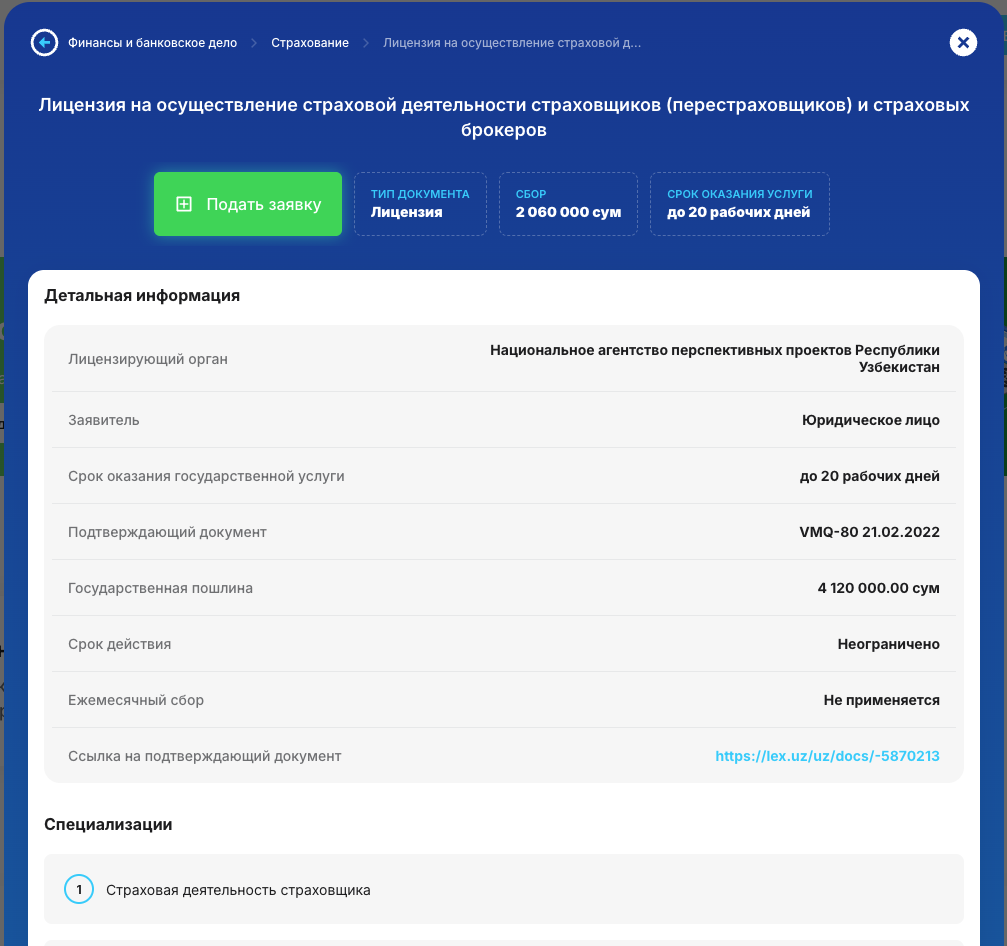
Insurance activity is governed by the Law "On Insurance Activity" (No. ZRU-730 of November 23, 2021). The licensing authority and supervisory regulator is the National Agency of Perspective Projects (NAPP).
The basic parameters of the license:
- Only a legal entity may apply, and it must be a joint-stock company (JSC).
- The license is issued for an unlimited term.
- No approvals from other agencies are required — a single authority makes the decision.
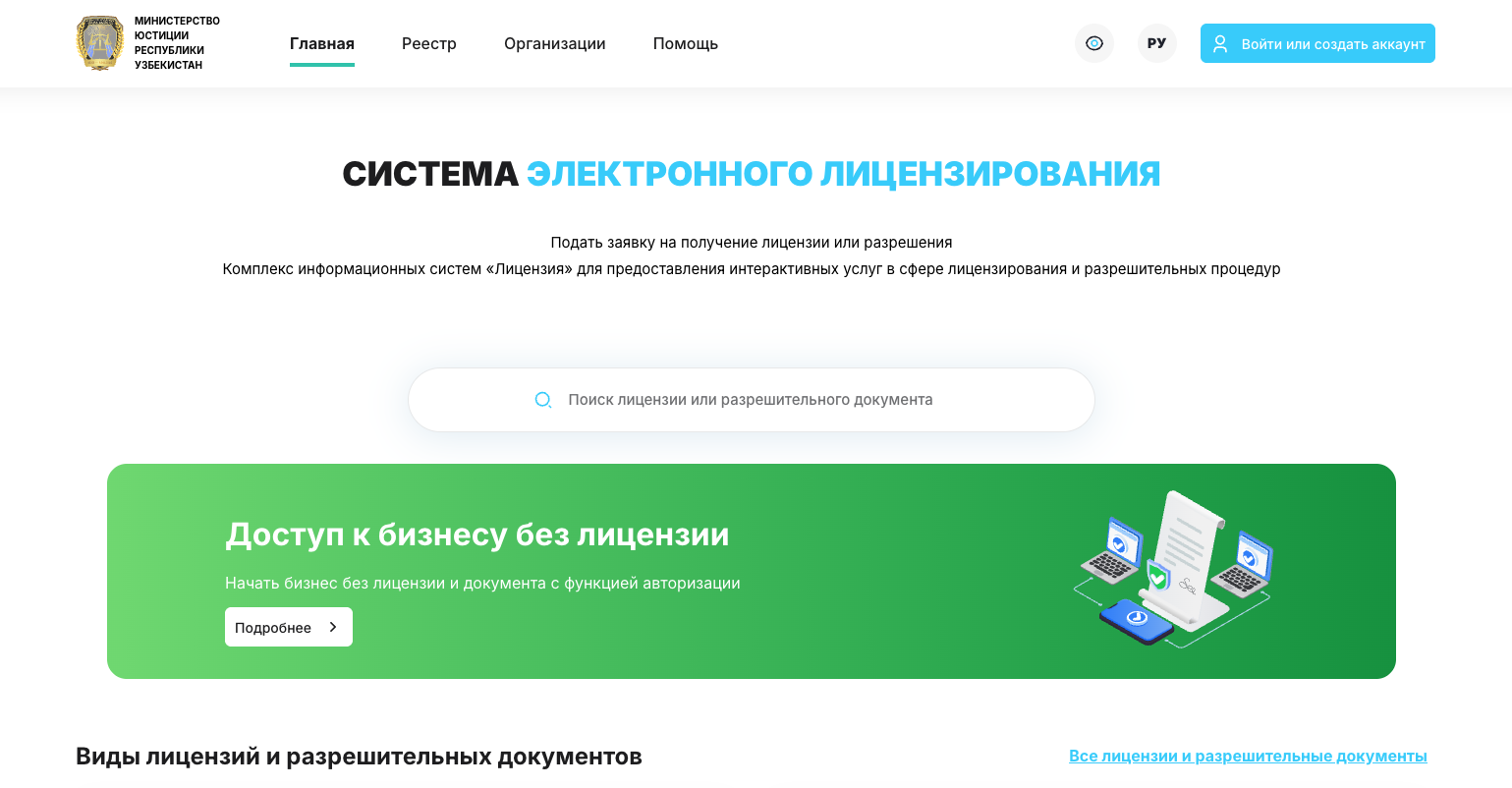
- Filing is done online through license.gov.uz (the "License" information system), and the application is signed with a digital signature.
The specifics — the list of documents, fee amounts, timelines, and grounds for refusal — are set not by the law itself but by the license passport (an annex to Cabinet of Ministers Resolution No. 80).
License Requirements and Conditions
The passport lists the requirements an insurer commits to comply with. It pays to know them in advance — some are checked right at the entry point.
General Requirements
- Compliance with AML/CFT legislation (anti-money laundering and countering the financing of terrorism), legislation on countering the financing of weapons of mass destruction, and personal-data protection law.
- Confidentiality of information obtained in the course of insurance activity.
- Providing information at the regulator's request.
- The chief executive and chief accountant must meet the qualification requirements (fit & proper — covered in a separate section below).
- Persons with unexpunged convictions for money laundering, terrorism, WMD financing, organized crime, drug offenses, corruption, or economic crimes in the IT sphere — as well as persons implicated in terrorism or WMD proliferation — may not serve in management or hold shares.
- The chief executive may not simultaneously hold executive positions in other insurance organizations.
- All documents relating to insurance activity must be retained for at least 5 years.
Additional Requirements for Insurers
- Charter capital not below the established minimum.
- An IT system for providing electronic insurance services.
- Registration of all contracts and issuance of policies through the Unified Automated Information System (UAIS) — mandatory since 2024.
- The ownership structure of corporate shareholders must have no more than three levels up to the ultimate beneficial owner (UBO).
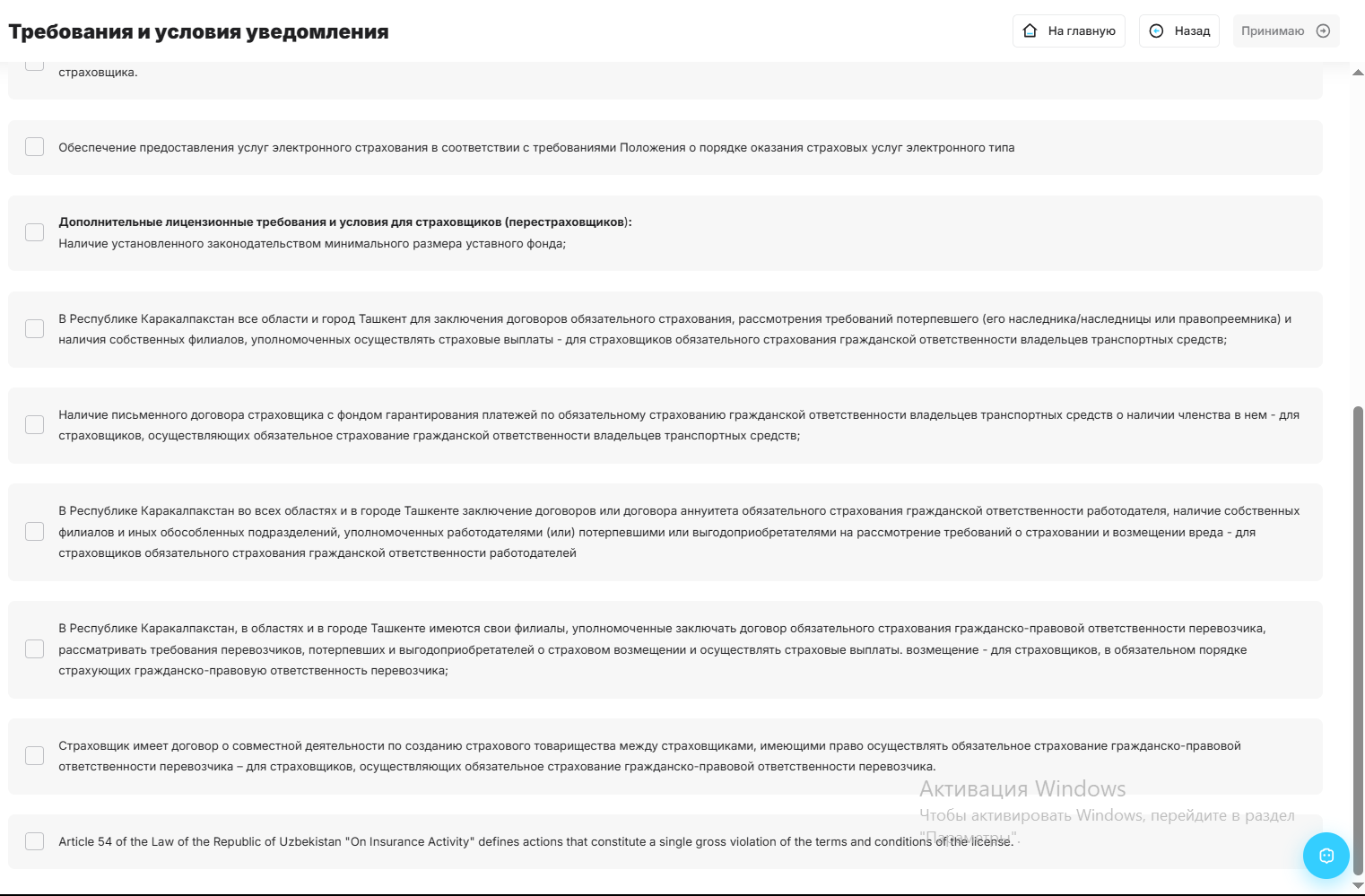
- For compulsory types of general insurance — regional branches and membership in the payout guarantee fund.
Insurance Classes — the Heart of the License
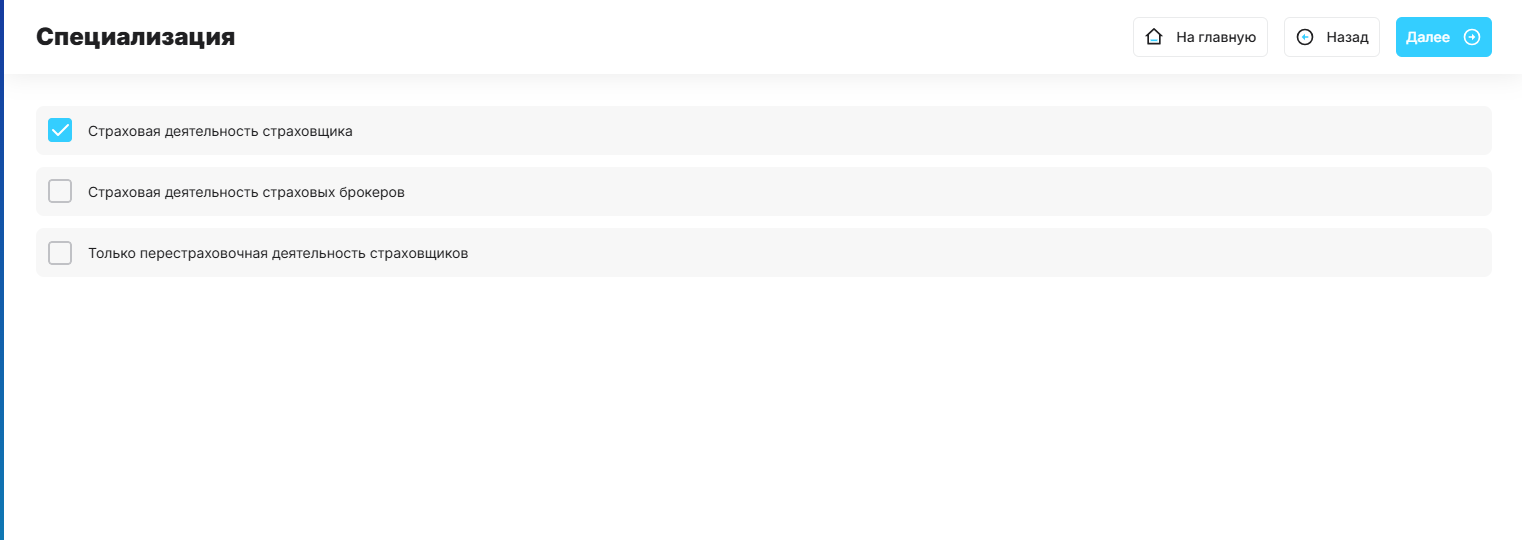
A license is a set of specific classes. You select the sector and classes directly in the application interface: 7 classes in life insurance, 18 in general insurance. This choice determines what the company will be able to do.
The Seven Life Insurance Classes
- Class I — life and annuities: payment upon survival to a specified term or age, or upon death, including periodic payments (annuities).
- Class II — marriage and birth: payment upon marriage or the birth of a child.
- Class III — long-term life insurance with a lifetime annuity.
- Class IV — health insurance: payments for injury or illness resulting in loss of working capacity (term of 5 years or more).
- Class V — life insurance tied to obligations: payment to a creditor or beneficiary if the insured dies before the debt is repaid.
- Class VI — long-term voluntary pension insurance.
- Class VII — life insurance with return of capital (with an investment component).
The Eighteen General Insurance Classes
In the law the classes are numbered 1 through 18:
- accident insurance;
- sickness insurance;
- land vehicle insurance;
- railway rolling-stock insurance;
- aviation insurance;
- marine insurance;
- cargo (goods-in-transit) insurance;
- property insurance against fire and natural disasters;
- property insurance against other damage;
- motor third-party liability insurance (MTPL);
- aviation liability insurance;
- marine liability insurance;
- general civil liability insurance;
- credit insurance;
- suretyship (guarantee) insurance;
- insurance of other financial risks;
- legal-expenses insurance;
- medical insurance.
Some types of general insurance are compulsory (MTPL, employer's liability, and carrier's liability). Additional requirements apply to them — see the sections on the Fund and on requirements.
A life insurer may take three classes from general insurance
At the end of the passport — in the fine print — there is a proviso: a life insurer is also entitled to operate in classes 1, 2, and 18 of general insurance:
- class 1 — accident insurance;
- class 2 — sickness insurance;
- class 18 — medical insurance.
In practical terms this is convenient: without obtaining a separate general license, a life insurer can cover the entire "life + health" perimeter — from accident and sickness to private medical insurance.
It does not work the other way around: a general insurer cannot enter the life classes. This is why the choice of sector at the start defines the entire product lineup.
Three Places Where the Real Work Begins
On the platform everything looks elementary: fill in the application, select the classes, attach the documents, sign with a digital signature, wait 20 days. But the application will not be accepted without the documents — and each one is a project of its own. Three of them are worth planning in advance:
- proof of charter capital;
- fit & proper clearance for management;
- the agreement with the Guarantee Fund.
Let's take them in order.
Charter Capital
The minimum capital is set by Presidential Resolution No. PP-108 (March 1, 2024). It depends on the sector and type of insurance and increases over the years (in millions of soums, effective October 1):
| Type of activity | 2025 | 2027 | 2029 |
|---|---|---|---|
| Voluntary general insurance | 35,000 | 45,000 | 60,000 |
| Compulsory general insurance | 50,000 | 75,000 | 100,000 |
| Voluntary life insurance | 25,000 | 30,000 | 35,000 |
| Compulsory life insurance | 40,000 | 45,000 | 50,000 |
| Reinsurance only | 80,000 | 100,000 | 120,000 |
For 2025 the minimum is UZS 25 billion for voluntary life insurance and UZS 35 billion for voluntary general insurance; for compulsory types — 40 and 50 billion respectively; for pure reinsurance — 80 billion. Aim for the threshold that will be in effect at the time you file.
By the time of filing, the capital must be sitting in the insurer's account — and proving this takes more than a single balance certificate. The regulator looks deeper and typically requests:
- a bank statement showing the movement of funds in the account — to see how the capital was formed and spent, and what the actual balance is;
- a letter from the Central Securities Depository confirming that the capital is registered to the shareholder.
Fit & Proper: the Most Demanding Part
The requirements for the chief executive and chief accountant are where projects stall most often. The requirements themselves are not complicated; more time is lost because the procedure for passing them is described only in general terms, and much has to be clarified on the ground.
The Formal Requirements
- Chief executive: higher education and insurance-sector experience of at least 3 years for candidates with a degree in economics, finance, or law, and at least 7 years for everyone else.
- Chief accountant: higher education (in accounting, finance, or economics) and at least 4 years of accounting experience, of which at least 2 years in insurance.
- A candidate cannot be appointed if, within the year preceding another company's bankruptcy or liquidation, they managed that company and their actions contributed to its failure.
Documents are submitted to the NAPP before the appointment. If everything is in order, the regulator issues a letter of compliance — which is then attached to the license application. In other words, fit & proper is completed in advance, as a separate step.

"The theory and practice of building a democratic society"
Among the requirements for the chief executive is knowledge of "the theory and practice of building a democratic society in Uzbekistan." One might expect this to involve an interview — but no interviews are held.
The wording is broad, and in theory it could be cited as grounds for refusal. In practice we have never seen it applied — but it is worth knowing about.
The Agreement with the Guarantee Fund
Another requirement that makes more sense in practice than on paper is the agreement with the Insurance Payout Guarantee Fund. Formally, it is not required for voluntary types or for general (non-compulsory) insurance.
Compulsory general insurance — additional requirements
For compulsory types (MTPL, employer's liability, and carrier's liability), the passport adds further conditions: own branches in Karakalpakstan, every region, and Tashkent, authorized to conclude contracts and make payouts, plus membership in the relevant payout guarantee fund. None of this is required for voluntary types or life insurance — which makes them lighter to launch.
The Step-by-Step Procedure on license.gov.uz
Let's pull it all into a sequence. The order is set by Cabinet of Ministers Resolution No. 80.
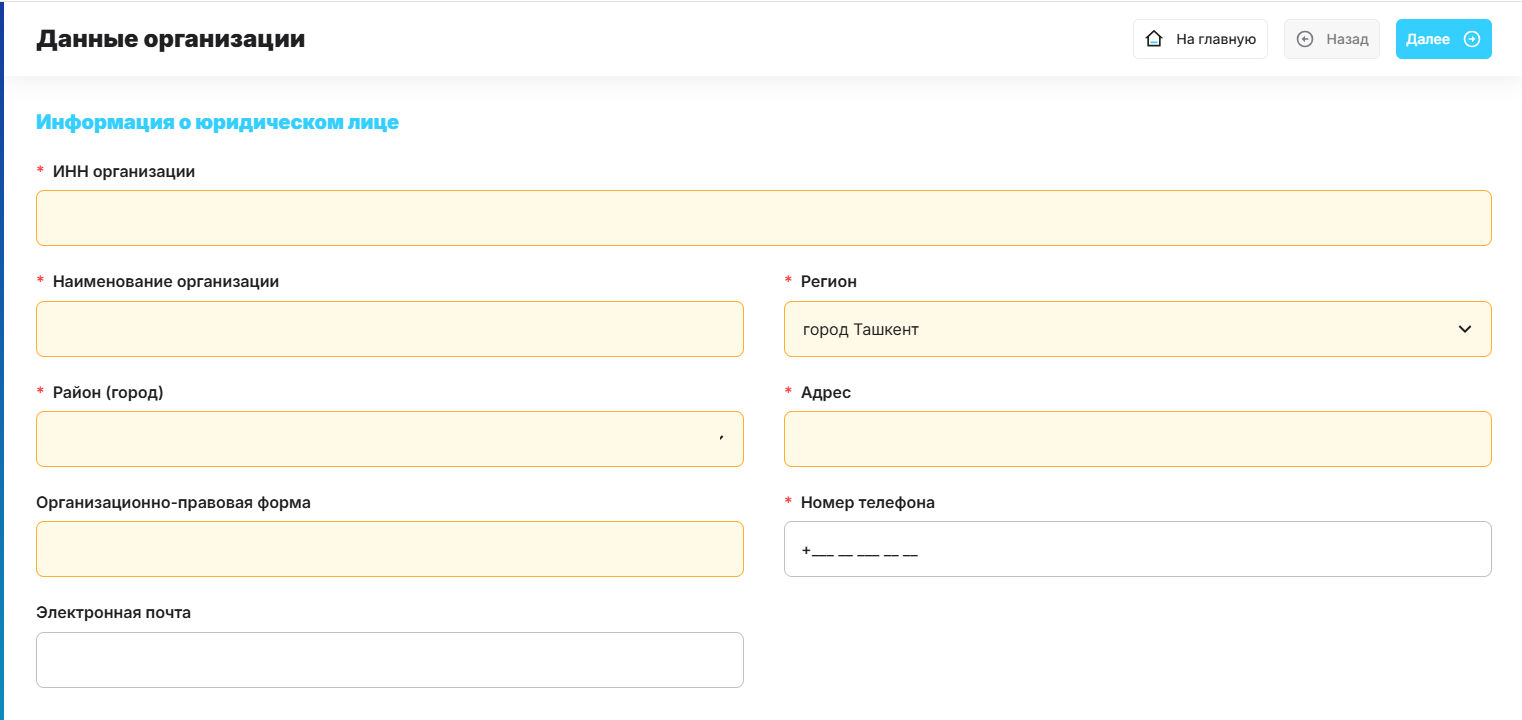
What the filing looks like step by step — from the home page to accepting the conditions. Click any screenshot to enlarge.
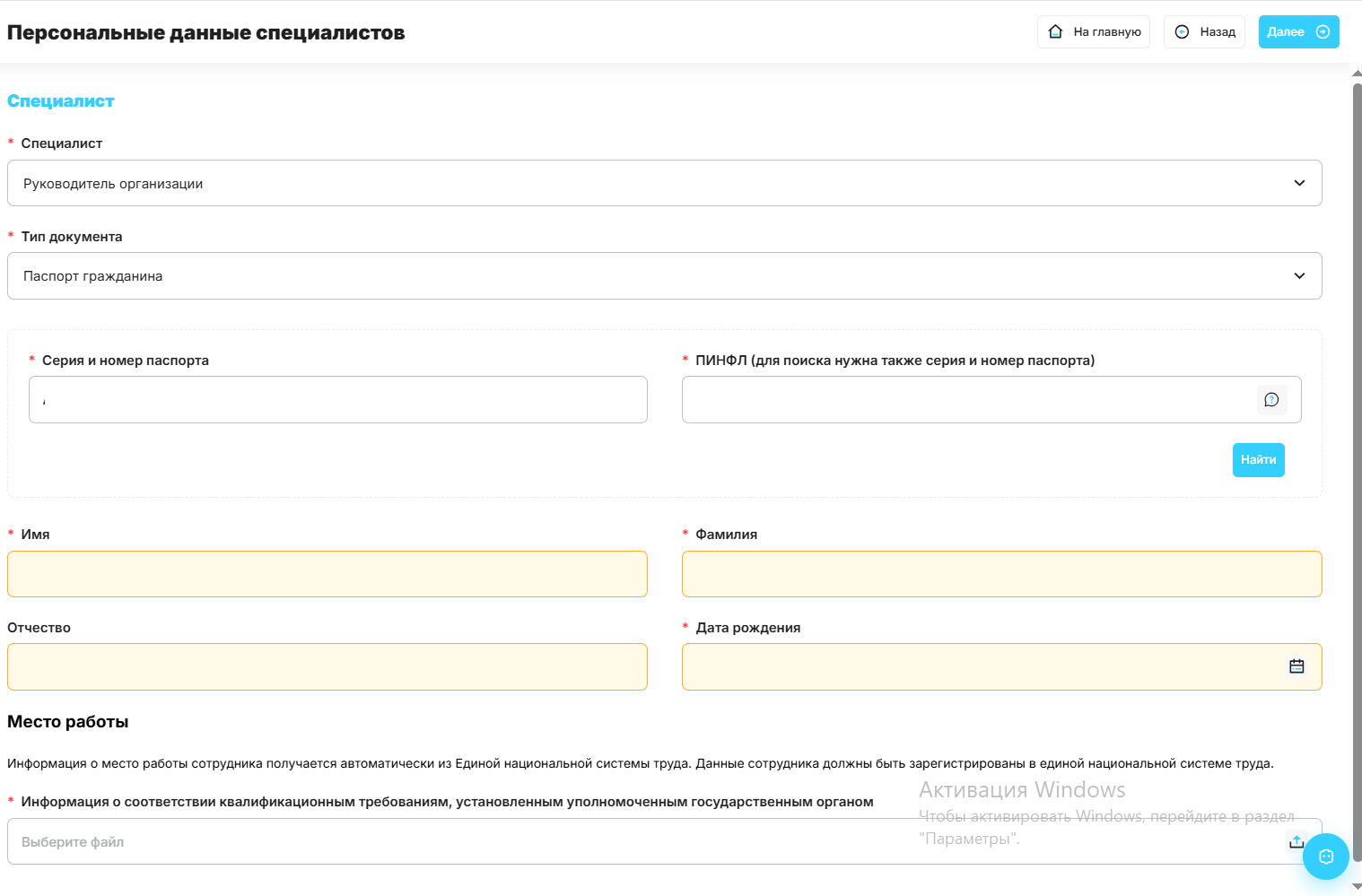
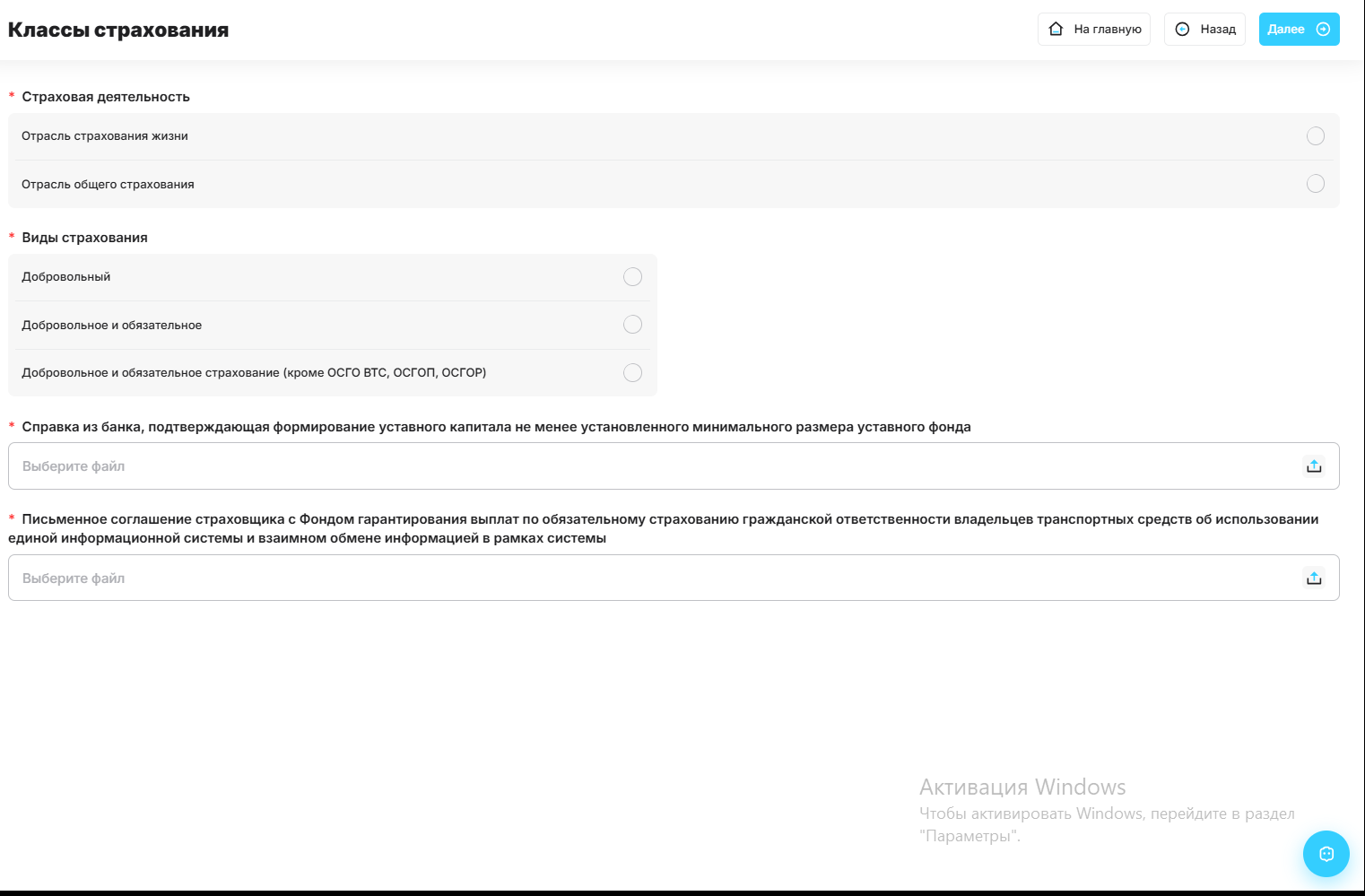
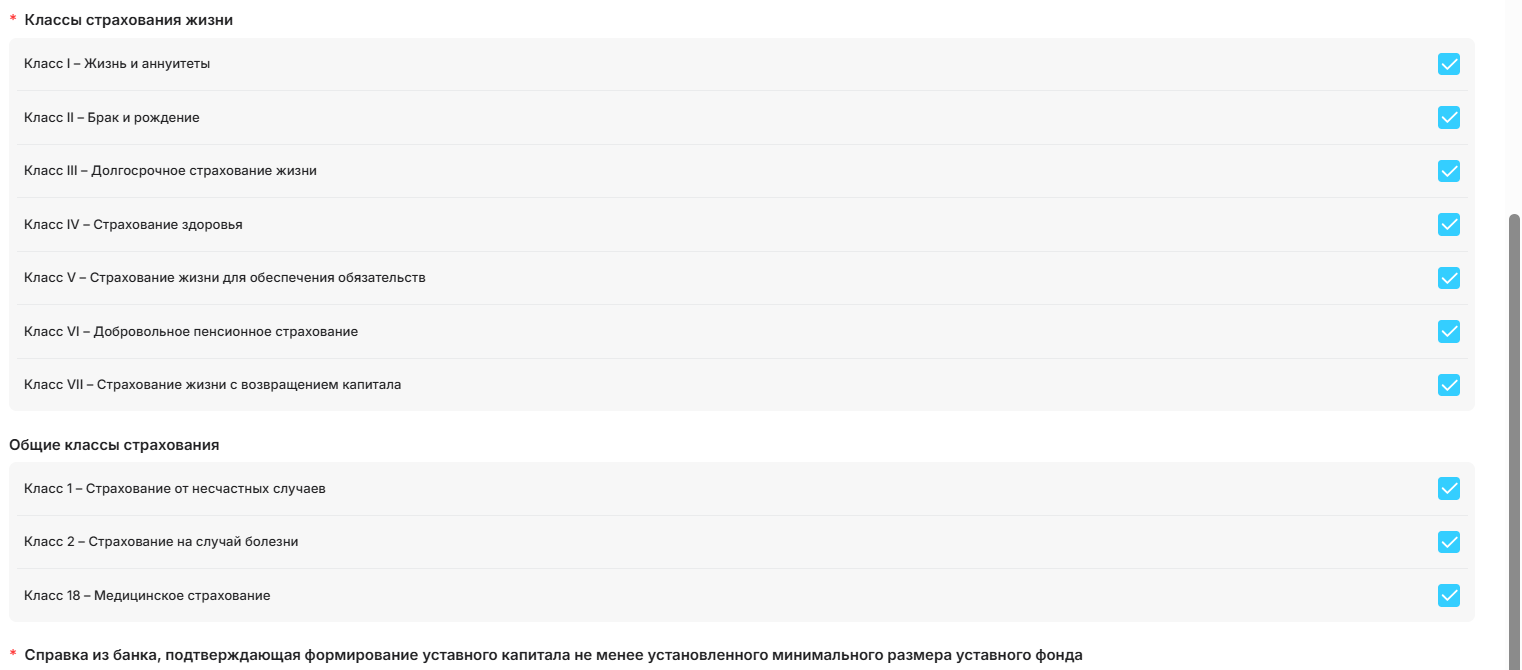
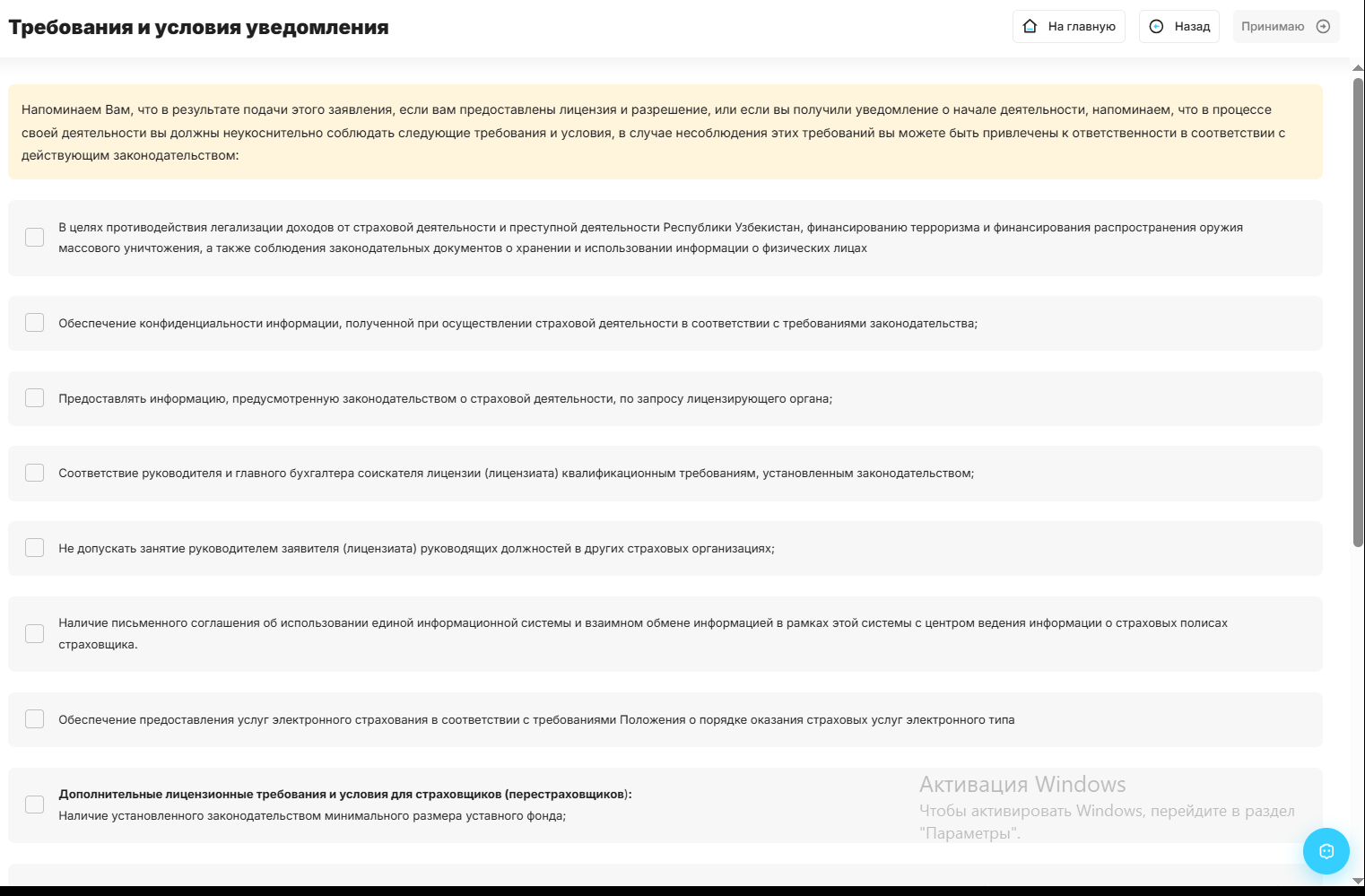
Step 1. Company and capital
Register the JSC, open an account, form and reserve capital to the required threshold, and prepare the bank statement showing the movement of funds and the letter from the Central Securities Depository.
Step 2. Fit & proper
Select a director and chief accountant who meet the requirements, complete fit & proper with the NAPP, and obtain the letter of compliance.
Step 3. The Fund agreement
Conclude an agreement with the Guarantee Fund to close the mandatory field in the application.
Step 4. Application and documents
The application is completed in the "License" information system: company details, choice of sector and classes, documents, digital signature. Attached to the application are:
- the application form with company details and the selected classes;
- proof of charter capital formation: a bank certificate, Central Securities Depository records on the placement of shares, and an account statement;
- the letter confirming that the chief executive and chief accountant meet the qualification requirements;
- the UAIS usage agreement.
Step 5. Fees
- Application review fee — 5 BCA (base calculation amounts) = UZS 2,060,000 (from September 1, 2026 — 2,200,000).
- State duty for issuing the license — 10 BCA = UZS 4,120,000 (from September 1, 2026 — 4,400,000).
Step 6. Screening and review
First comes an automatic check through the "License" system. The application will not be accepted if it contains inaccurate data, the fee is unpaid, the requirements are unconfirmed, the applicant already holds such a license, or its activity has been suspended or prohibited by a court. Then comes the substantive review — up to 20 business days.
Deficiencies come with a chance to fix them first
If the package is incomplete or has remediable shortcomings, the regulator does not refuse outright but sends a notice with a deadline for corrections (up to 30 business days). The review is suspended for that period. Refusal on new grounds not stated in the notice is not permitted.
Step 7. Decision and license
The decision is made in the system with a digital signature and arrives in your personal account. If there are no deficiencies, an approval decision is issued, and the license appears on license.gov.uz within two days. There is also a "silence is consent" rule: if the regulator misses the deadline, you may begin operating upon notification, and a license with a QR code is generated in the system.
When Refusal Happens — and Where Applications Get Stuck
The list of grounds for refusal is exhaustive. A refusal is possible only if:
- the documents are submitted incomplete;
- the applicant does not meet the requirements;
- the documents contain inaccurate or distorted data;
- a mandatory expert review returns a negative conclusion.
Refusal on any other grounds — including "inexpediency" — is not allowed. And if the deficiencies are remediable, the regulator must first grant time for corrections rather than refuse outright.
In practice, applications are more often returned for revision than rejected: an incomplete package, questions on fit & proper, inconsistencies in the capital documents, an unclosed Fund field. All of this can be resolved before filing.
Bottom Line
An insurance license in Uzbekistan is a transparent procedure, identical for both sectors: choose the sector and classes, form the capital, file online, wait 20 business days, and receive a license of unlimited duration.
The key is not the platform but the preparation: fit & proper, proof of capital, the Fund agreement, and the UAIS and ownership-structure requirements. Each is solvable on its own; together they determine whether you meet the deadline or drift into months of correspondence.
Our experience saves the most time and reduces the most risk where it comes to: foreign shareholders and directors (certifying diplomas, proving foreign work experience, questionnaires), proof of capital (movement of funds, the Depository letter, spending before filing), and navigating fit & proper in dialogue with the regulator.
Launching an insurance company? Let's talk.
Juris Advisory handles insurer licensing end to end: from choosing the sector and classes, structuring the capital, and fit & proper clearance for management, to filing on license.gov.uz and obtaining the license.
Get in touch →